

January 20, 2025
Paint Correction Explained: Enhancement vs. Full Correction
Why paint looks dull
Look at a dark car in direct sun and you'll see it: a spiderweb of fine scratches radiating around the light. Under fluorescent lights at a gas station, a haze that flattens the color. On older cars, a chalky dullness that no wash brightens.
None of that is dirt. It's damage to the clear coat — thousands of microscopic scratches from automatic car washes, dirty wash mitts, drying with the wrong towel, and years of dust dragged across the surface. Each scratch scatters light instead of reflecting it, and enough scattered light reads as dull.
Wax and glaze can fill and hide these for a few weeks. Paint correction removes them.
What correction actually is
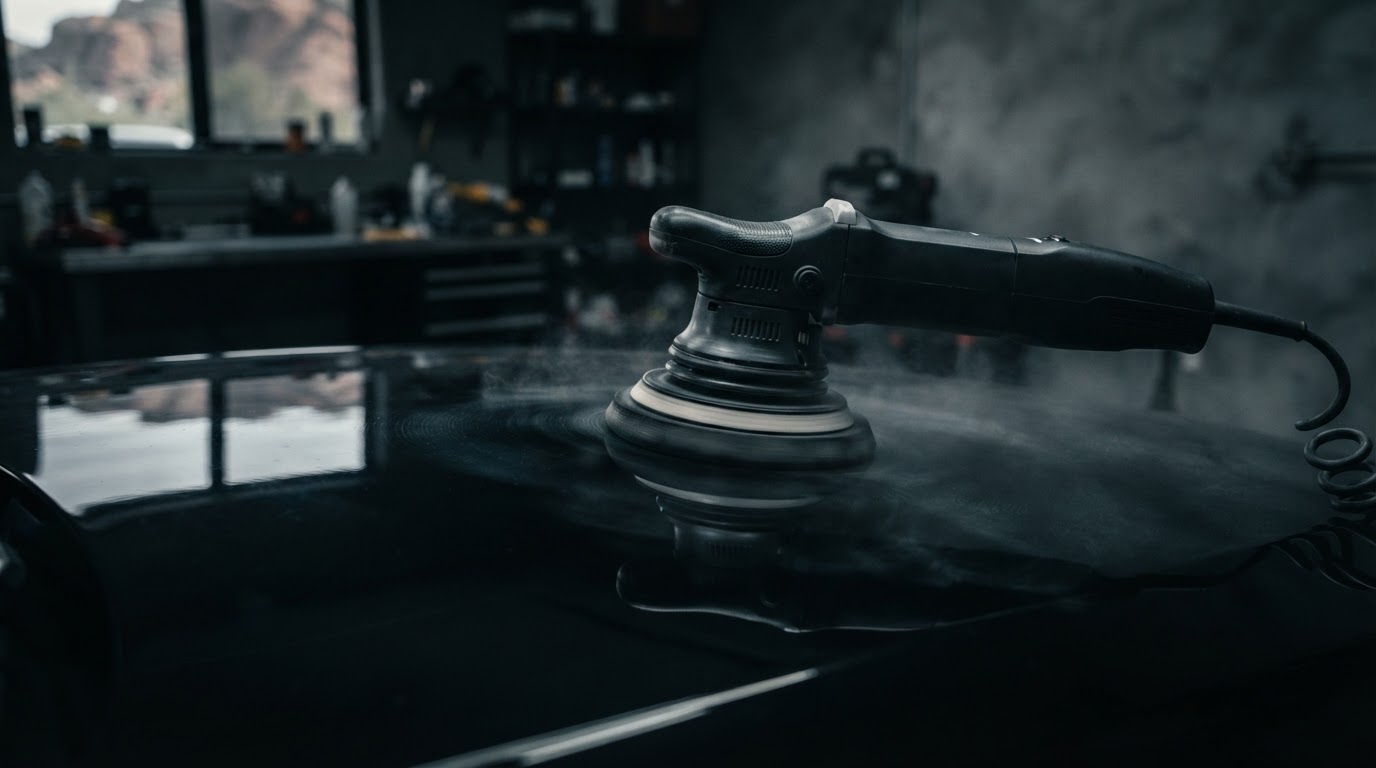
Paint correction is machine polishing: a dual-action or rotary polisher, a pad, and an abrasive compound or polish, used to level the clear coat by removing a very thin layer — measured in microns — until the surface is flat enough to reflect light cleanly again. The defects aren't covered; they're gone.
It's done in stages. Compounding uses a coarser abrasive to cut deeper defects. Polishing uses a finer abrasive to refine the surface and bring up clarity. The number of stages determines how much defect removal you get and how long the car is in the shop.
Enhancement: single-stage
A single-stage enhancement is one polishing pass with a finishing pad and polish. It removes light swirls, haze, and water spotting, and it restores the gloss and depth of paint that's in decent condition. It typically removes 50–70% of visible defects.
This is the right choice for newer vehicles, well-kept paint, and anything being prepped for a ceramic coating — which is why a polishing stage is included in every coating package we offer. At Empire, enhancement runs $250–$350 depending on vehicle size, and most vehicles are done the same day.
Correction: two-stage
A two-stage correction adds a compounding pass before the polish. The compound cuts through deeper swirls, moderate scratches, oxidation, and buffer trails left by previous bad work. The polish then refines what the compound left. Expect 80–90% of visible defects removed.
This is what most luxury and enthusiast vehicles need if they've been through a few years of ordinary washing. At Empire it runs $500–$700 by vehicle size and takes one to two days.
Perfection: multi-stage
For show cars, exotics, and fresh resprays where the standard is flawless, multi-stage work adds wet sanding where needed, multiple compounding and polishing stages, and panel-by-panel refinement. It's priced per vehicle after inspection because the variables — paint hardness, defect depth, clear coat thickness — are different on every car.
How we decide which one you need
We don't decide from the menu. We decide at the assessment.
Every vehicle gets paint-depth readings on every panel with a gauge before anyone touches it. That tells us how much clear coat there is to work with, which sets the ceiling on how aggressive we can safely be. Then we map the defects under LED inspection lighting. Then we recommend the lowest level that actually fixes what's there, and you approve the plan and the exact price before we start.
Some scratches don't polish out. If a scratch is deep enough to catch a fingernail, it's usually through the clear coat, and correction can't fix it — that's touch-up or repaint territory. We'll tell you which is which.
What happens after
Corrected paint is unprotected paint. The correction removed the defects; it did nothing to stop new ones. This is the moment to apply protection, and because the paint is already prepped, it's the most cost-effective time to add a ceramic coating. Book them together and the polishing stage in the coating package is replaced by your full correction — you don't pay for prep twice.
Related services
Ready to see the difference?
Book a drop-off assessment at our Southern Utah shop. Exact price before any work begins.